LSSGB vs SSGB: Understanding the Difference in an AI-Driven Business Environment
Lean Six Sigma Green Belt (LSSGB) and Six Sigma Green Belt (SSGB) training have become essential pathways for professionals who want to strengthen their problem-solving skills, lead improvement projects, and deliver measurable value to their organizations. As businesses increasingly adopt AI-enabled tools for analytics, automation, and decision support, these certifications provide the structured foundation needed to apply technology effectively. Whether you work in operations, supply chain, healthcare, finance, or service industries, Green Belt training equips you with a disciplined approach to eliminate waste, reduce variation, and improve customer outcomes.
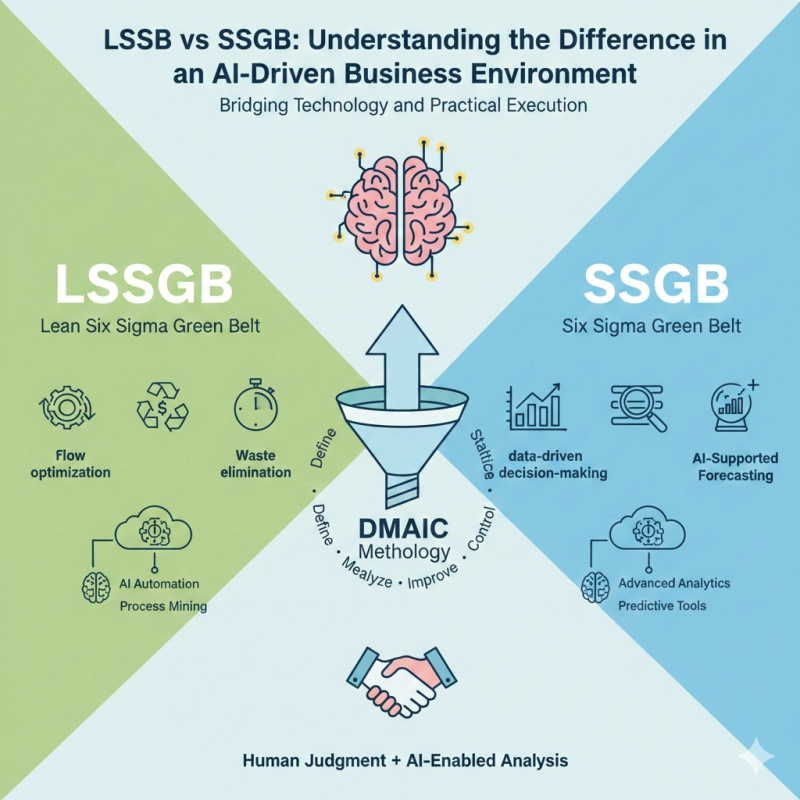
Green Belt programs focus on developing practical, hands-on capability. Participants learn to analyze processes, identify root causes, and implement sustainable solutions using the DMAIC methodology: Define, Measure, Analyze, Improve, and Control. This structured approach complements AI-driven insights by ensuring that data, automation, and predictive tools are applied within a clear problem-solving framework. The training blends analytical thinking with real-world application, enabling professionals to translate data and AI outputs into meaningful business improvements.
LSSGB vs SSGB: Key Differences in the Context of AI and Data
While both certifications share a common foundation, they differ in emphasis.
Lean Six Sigma Green Belt integrates Lean principles such as flow optimization, waste elimination, and cycle-time reduction. In an AI-enabled environment, this approach supports the use of automation, process mining, and workflow optimization tools to improve speed and efficiency while maintaining customer focus.
SSGB places greater emphasis on statistical analysis and data-driven decision-making. This makes it well suited for environments where advanced analytics, AI-supported forecasting, and performance measurement are critical. SSGB professionals are typically involved in interpreting complex data sets, validating insights, and ensuring that AI-driven recommendations are statistically sound.
Together, LSSGB and SSGB provide a balanced skill set that helps organizations combine human judgment, structured methodologies, and AI-enabled analysis to drive continuous improvement.
Green Belt training is designed for professionals who want to lead improvement initiatives without stepping away from their core roles. It is particularly valuable for team leaders, supervisors, analysts, project managers, and professionals responsible for operational performance. As AI becomes more embedded in business processes, these skills help professionals bridge the gap between technology and practical execution. The competencies gained are transferable across industries and support both career progression and organizational impact.
What You Gain from Green Belt Training in an AI-Enabled Workplace
Participants develop a strong understanding of process mapping, data collection, root-cause analysis, and solution implementation. Beyond technical tools, they gain the ability to frame problems correctly, interpret insights from data and AI systems, and lead initiatives that deliver measurable results. Green Belts often act as change agents, helping organizations adopt new technologies while maintaining process discipline and continuous improvement principles.
Why This Matters Now
In a rapidly evolving business environment shaped by digital transformation and AI adoption, organizations need professionals who can combine structured problem-solving with modern analytical tools. LSSGB and SSGB training provide the methodological foundation required to ensure that AI-driven improvements are effective, sustainable, and aligned with business objectives. For individuals and organizations alike, Green Belt certification remains a strategic investment in long-term capability building.